
Disclaimer
“Knowing is not enough, we must apply. Willing is not enough, we must do.”
Bruce Lee
Knowledge of technique is useful for the analytical tricker and imperative for tricking coaches. Remember however, that technique must be trained, not simply understood.
Technique: Overview of Set and Order of Operations
“Understanding music theory means knowing the language of music. The main thing to know about music theory is that it is simply a way to explain the music we hear. Music had existed for thousands of years before theory came along to explain what people were trying to accomplish innately by pounding on their drums. Don’t ever think that you can’t be a good musician just because you’ve never taken a theory class. In fact, if you are a good musician, you already know a lot of theory. You just may not know the words or scientific formulas for what you’re doing. . .
. . .There are plenty of intuitive, self-taught musicians out there who have never learned to read or write music and find the whole idea of learning music theory tedious and unnecessary. However, just like the educational leaps that can come with learning to read and write, music theory can help musicians learn new techniques, perform unfamiliar styles of music, and develop the confidence to try new things.”
Technique in Tricking is akin to music theory. It explains things. It’s the pattern to follow when you’re exploring new territory. You need not study to understand some of it, but understanding technique will allow you to troubleshoot why something does or doesn’t work. Why do olympic gymnasts put faith in coaches when they are competing harder skills than their predecessors dreamed of? They understand technique, how to change technique, and how to train technique, in addition to other mentor qualities. If you are a tricking coach, it is your imperative to also be conscious of understanding technique, how to change technique, and how to train technique.
Understanding Technique
“Perfection is achieved, not when there is nothing more to add, but when there is nothing left to take away.”
Antoine de Saint-Exupery
The idea is that perfect technique is completely efficient and maximizes the traits required of a skill. Each body movement is intentional and will either help with height, twist, flip, or the kick/variation. Perfect technique is a fantastic goal to strive for, but I think it can be agreed upon that effective technique is what exists in reality. Does your technique do what you need it to do? Are you fighting yourself or is your body working as one unit? Does your cork tech give you the right amount of height, flip, and twist for dub, trip, and beyond? There are so many unique skills in tricking that several aspects of technique will be suited to the individual; however, the set and order of operations of a trick are easily analyzed aspects of technique. Further down in this article, we will discuss technique for the set and order of operations in tricks.
How to Change Technique
“I tell a student that the most important class you can take is technique. A great chef is first a great technician. ‘If you are a jeweler, or a surgeon or a cook, you have to know the trade in your hand. You have to learn the process. You learn it through endless repetition until it belongs to you.'”
Jacques Pepin
This goes back to the first pillar: 4P: (1) Consistency is Key. Have you ever worked on the technique of a skill for a whole session, making bounds of improvement, only for it to go back to the way it was the very next session? Remember that your tricks reflect your habits. Therefore, you must make changes that stick through consistently training one or a few things for several sessions. In this way, consistency is at least as, if not more important than knowledge of perfect technique.
How to Train Technique
Use drills for tricks with unfamiliar concepts. Drills isolate certain parts of the movement that you can focus on rather than being overwhelmed by several variables. Find and discuss drills here on the Tricking Drills Facebook. If it’s a skill you can already do that you are trying to improve, train it in the context of momentum. Remember our athlete vs. tricker example from the second pillar: 4P: (2) Momentum? “. . .[He] uses a better, more efficient technique. It is more efficient because it builds momentum, maintains momentum, then releases the momentum upwards into the final skill.” Training tricks to be momentum building/conserving will point you in the direction of correct technique for the low and medium height tricks whereas training momentum capitalization will move you toward the best height/flip/twist ratios for the high tricks.
Technique vs. Form
You can’t get to the big skills without effective technique. You cannot maximize the use of your strength and momentum without effective technique. That said, do not confuse good technique with good form. Although many trickers have beautiful form as well as effective technique, there are quite a few trickers near the top that have effective technique without that paying much attention to form. I’m sure you can name a few. Technique, as a pillar of the Sport of Tricking, should be a priority to improve while Form is facet of the Art of Tricking. You need effective technique to perform your skills, but form can be improved at your own pace.
Whether or not an effective technique is aesthetic, it will maximize the necessary ratios for height, flip, twist, and any variations for any particular skill.
Technique covers:
- Set
- Getting the right height
- Initiating flipping rotation
- Initiating twisting rotation
- Order of Operations in Twisting Maneuvers
- The Flip Heavy: [Set->Flip->Twist] + Variation
- The Invert Twist Heavy: [Set->Twist+Flip] + Variation
- The Vert Twist Heavy: [Set->Twist->Flip] + Variation
The set of a trick dictates the allocation of your momentum into your height and your initial flipping and twisting rotation.
Timing is imperative to tricking’s multi-faceted elements. The order of operations will determine what kind of trick you ultimately end up with.
Setting: Height/Flip/Twist Ratio
Height equals time for trickers. If you’ve got a lot of height, you have the time to do what you need to do in the air. High skills are the big momentum capitalizing skills. They normally require a powerful setup and/or run up and try to maximize height.
Medium height skills are the tricks that transition back into momentum conservation/building right away. They need less height and a bit more flip in order to land in a good position to keep moving across the floor.
Low skills are the momentum building tricks that prioritize flip over height. They include setups like switches, touchdown raiz, and the like.
Although we’d like to imagine all tricks at maximum height, some variations require more flip or more twist. For double flips, for swings, etc., you must initiate extra flip which will sacrifice a little bit of height in your set. If you add a twist or multiple twists to a trick, you’ll again have to sacrifice a little bit of height and flip in order to make that happen.
To change the amount of flip and height in your set, you want to variate your hip and shoulder angles with respect to the floor.
To initiate twisting rotation in your set, you must rotate your hips and torso during your set.
Important Angles of the Set
Entrance Angle: The angle you achieve as you are entering the floor with the plant leg.
Take-off Angle: The angle you achieve as you are leaving the floor.
Hip Angle: The angle of your plant leg (hip through toes) with respect to the floor.
Shoulder Angle: The angle of your shoulders (shoulders through trunk) with respect to the floor.
Surface speed (slowest to fastest):
- Fast track
- Air trick
- Rod Floor
- Sprung Floor
- Grass/Dead floor
- Concrete
The faster the surface speed, the shallower the entrance angle will be.
The slower the transition speed, the shallower the entrance angle will be.
Transition speed (fastest to slowest):
- Punch (Rebounding)
- Swing/Wrap/Rapid
- Vanish/Pop
You can hit a steeper entrance angle on punches than swings, so you have more potential height in punches. You can hit a steeper entrance angle on sprung floor than on grass, so you have more potential height in the gym.
Here are the “rules” of setting angles:
- The ideal take-off angle should follow the path of momentum rather than deviating.
- The ideal entrance angle is different between faster/slower surfaces, faster/slower transitions, and high/medium/low tricks.
- The ideal take-off angle for maximum height should shoot you nearly straight upwards (~90°).
- The ideal take-off angle for momentum building should approach 45° with the hip angle.
- The ideal take-off angle for momentum conserving should approach a 45° shoulder angle and a slightly past 90° shoulder angle.
Note the entrance/take-off angle in the hips, the take-off angles in the shoulders, and the twisting between the entrance/take-off angles of the following examples.
High vs. Low Take-offs
Pictured below are two take-off angles. Can you tell which will be a low power building skill and which will be a high dismount? The triple has a take-off angle to maximize height, so both shoulders and hips are near straight up. The whip take-off is maximizing length and flip, so both shoulders and hips approach the backwards 45°. Both have no twist or layout flip, so they are fairly ideal examples.


High vs. Low in Swings + Twisting
Below is a killer swing combo. Peep the change in hip angle from straight to leaning back in the switch (left) ideal for building momentum. Both the shoulder and hip angles reach toward the backward 45° for take-off.
The change in hip angle from leaning forward to straight up in the triple (right) is well-suited to capitalizing on the momentum built. Notice the shift in body position to improve twisting rotation (bottom right).


Height + Flip
Tumbling tracks allow for deep entrance angles but the take-off angle of the hips should still be nearly vertical. Here is an example of Kallum hitting a double layout variation requiring both height and extra flip from the shoulders. His hip angle is close to vertical while his shoulder angle approaches that backwards 45°.


Low Flip + Twist
Momentum building corks exercise both flipping and twisting elements and require a tad more height than switches. As such, a shallower backward hip take-off is a good compromise as long as the shoulder angle still pulls toward 45°. Notice Abel’s twist in the hips and shoulders at take-off.
The set in the thumbnail is for a medium height, momentum conserving icy cork. Dub dubs will probably be in that range. Hip and shoulder angle are quite a bit more vertical, but he still retains some flip to continue his swing chain.
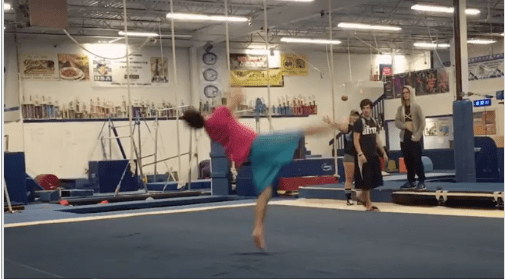
https://www.instagram.com/p/BXlTgBwjs5c/?taken-by=ispamquads
Equal but opposite is true with the traditionally momentum building raiz. Forward hip-angle and aggressive shoulder angle. Twisting with the shoulders and hips in the beginning leaves time for the eagle at the end. Forward take-off skills like cart, raiz, etc., have more room for shoulder lean.
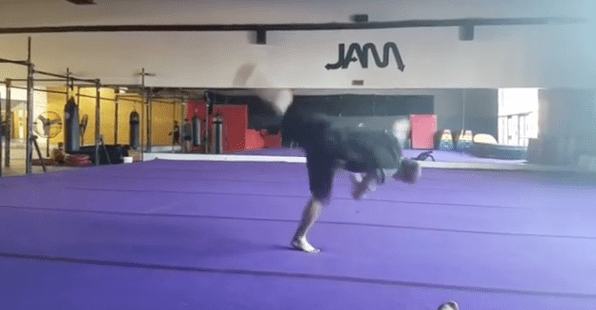
Angles on Sequential Dismounts
Vanish dismounts can hit straight take-offs as well as any singular and sequential transitions. The entrance angle for this tak trip would be be counted from the time the plant leg makes contact (top left) rather than the vanishing leg (top right). Notice the 90°+ turn from the entrance to take-off positions to maximize twisting. [Order: top right, top left, bottom]


https://www.instagram.com/p/BRBUPXLAlVQ/?taken-by=ilyavtorin
https://www.instagram.com/p/BTHSwMzA_8l/?taken-by=ilyavtorin
Setting tl;dr
The set for height/flip/twist is all about the angles. You’ll gravitate toward the right angles as you practice in the context of momentum building/conserving/capitalizing. In the way that music theory follows the music the right angles will follow effective practice of momentum control. Use the entrance and take-off angles to check whether tricks are moving efficiently for their purpose. Do the angles assist the goals of the tricker?
Order of Operations
Most tricks have both a degree of flip and twist to it. There are a lot of different styles of flip twisting available to trickers, dictated by their order of operation. The set will nearly always include initiation of flip and twist, but once off the floor, the order which you choose to pull in the flip and twist may vary with your goals.
In gymnastics, double flips with a couple twists are awarded better bonuses than single flips with several twists. Thus, gymnasts will learn to prioritize flip, and will tend to exaggerate the flip [Set->Flip->Twist]. Trickers who aim to transition out of a trick would do well to use this order of operation to flip enough to enter the next skill properly.
Vert kicks and some styles of inverts don’t require much flip, and can benefit from prioritizing twist [Set->Twist->Flip].
Trickers who hunt higher twists and variations between, still need a modest amount of flip while prioritizing twist. Many resolve this by pulling for twist and flip simultaneously for the best ratio [Set->Twist+Flip]. Next we will examine different orders of operation.
Flip Heavy [Set->Flip->Twist]
USA National Trampoline Team member Jeff demonstrating back skills. Below is the trampoline gymnastics style of exaggerated flip set before the twist important in higher flipping elements.
Twist Heavy [Set->Twist->Flip]
The most common use of the twist heavy order of operations is Vert kicks. When Jordan hits a mainstream BS 16 his set has a residual amount of flip. In air, he only pulls twist before the kick [Set->twist->kick].
Compare the above with Pot’s insane standing dub pop dub. Instead of a kick, he hits [Set->twist->flip]. His set initiates flip and twist, but prioritizes twist. He then twists to near completion, tucking in at the end to return to feet.
https://www.instagram.com/p/BXLF9WHAoNJ/?taken-by=ogilvie_maurice
Here, Nick hits a slo-mo example of another twist before flip. The set of his full-up initiates both flip and twist, but he only pulls in for the flip after the twist is nearly complete. [Set->Twist->Flip]
https://www.instagram.com/p/BXjgv2XgfJm/?taken-by=nickfryy
Standard Tricking [Set->Twist+Flip]
Here is a prime example of the most classic tricker-style power twist. In higher twisting elements (3:1 twist to flip), the twist is prioritized but the flip is integrated into the twist. This leaves enough flip to initiate a wide range of extra variations before, during, and after the twist (eg. dragonfly, snapu, hyperhook). In this slo-mo trip, Ryan pulls twist with flip simultaneously.
This is also a another great example of using the set to initiate extra flip from the shoulders. With hips straight up for height, shoulders pull for flip similar to the example for the double stag layout. Of course, Posi only needs to pull for one flip, so his shoulder angle is a lot less exaggerated.


Polin hits a beautiful trip variation.
Order of Operations tl;dr
Make sure that the order of operations you choose aligns with your goals. If you’re trying to hit cart dub swing dub, you should aim for inversion and prioritize your flip [Set->Flip->Twist]. If you want to twist high on low momentum, or hit high-rotation vert kicks, you need to squeeze in as much twist as you can early on [Set->Twist->Flip]. If you are after the classic power and variation in most of tricking, try to integrate your flip and twist [Set->Twist+Flip]. Each come with their own aesthetic, so Artists out there: choose accordingly!
 Mercenary Tricking