
Physicality in Tricking:
Every professional athlete undergoes intensive training for the body in and out of their sport. Whether it’s running, circuit training, lifting weights, or otherwise, the idea is to condition the body for the best possible edge in performance.
If effective technique includes all the right shapes, angles, and timing to perform skills, then physicality is the strength, mobility, and uninjured-ness that allows the body to achieve effective technique.
- Trickers must have a functional vessel to train in. Pre-hab prepares the body for the rigors of tricking.
- Trickers need to have skill-specific mobility in order to effortlessly move through effective and aesthetic positions.
- Trickers need to have a lot of skill-specific strength in order to flip and twist tighter.
- Trickers need to have a lot of elastic power to be able effectively bound and rebound.
- Trickers need to have a lot of explosive power to be able to effectively jump from standing or low momentum.
We’ll begin with an overview of strength training strategies utilized by elite athletes, then continue on to pre-hab and mobility strategies supported by current peer-reviewed literature.
Strength Training Overview
Strength is necessary to move your body into the right positions but remember that strength is only useful when applied at the right timing. Increasing maximum strength is a topic that has been covered many times over; it’s a worthy endeavor for its own sake, but a bit over-rated for performance.
It is not the strongest trickers that are the most successful, but those with the most skill-specific strength, power, and elasticity. If you were to ask the top performing trickers, gymnasts, track athletes, dancers, or martial artists their max deadlift, squat, and bench, I doubt they would even know or care. Don’t use high loads for the sake of an exercise unless that’s a side project of yours.
Traditional Strength vs Power Explanation
Strength is the amount of force a muscle, or group of muscles, can exert against and external load. A 1-repetition maximum test is performed where a trainee assesses the greatest weight they can lift with proper form. Speed of the movement is not important when testing strength. It is developed by lifting heavy weights normally around 80 percent or more of the trainee’s 1-rep max. . .
Power is defined as the ability to generate as much force as fast as possible. It is needed for athletic movements such as olympic movements (clean and jerk), swinging a baseball bat, swinging a golf club, and running through a tackle. Power does require strength and speed to develop force quickly. The load or resistance must be heavy enough to allow for maximal force to be applied but not so heavy that the exercise is performed too slowly. . .
- Strength is maximal force production.
- Power is Strength with Speed.
99% of tricking “strength” is about strength with speed. Instead of comparing traditional strength and power, the differentiation for trickers should be between Explosive Power and Elastic Power.
Explosive Power vs Elastic Power
A stretch-shorten cycle (SSC) is defined as an eccentric contraction followed by an immediate concentric contraction. The shortening (concentric) phase of a SSC is more powerful, does more work, than the shortening (concentric) phase of a concentric only contraction.
- A stretch & contract (quick bend then jump) yields greater height than just a contraction (sitting box jump).
- A stretch & contract following momentum (Elastic Power) will yield greater height than a stationary stretch & contract (Explosive Power)
- Elastic Power can be improved using plyometric-based training to increase elastic SSC output
- Explosive Power can be improved with sprinting, jumping, and weightlifting to increase explosive SSC output.
Guys who are “Strength Jumpers” [Explosive Power] tend to have better standing vertical jumps because of the amount of force they can deliver into the ground from a stand still. This is why you see guys at the NFL combine with standing verts 40+ inches!! Having a 40+ standing vertical jump in the NBA is extremely rare, but it has been done. Even the man Michael Jordan himself only had a 37.5 inch standing vert. . .
. . . “Elastic Jumpers” [Elastic Power] tend to need to build up some momentum prior to jumping. Once they build up this momentum you see their verts start to really get up there. The gap between a basketball players’ standing and running vert is much larger on average than one of a football player. . .
Explosive Power based trickers rely on their ability to muscle tricks from almost no momentum whereas Elastic Power based trickers go to great lengths to really try to utilize their momentum.
Explosive Power: Traditional power with little momentum going into the SSC
eg. Standing vertical, standing skills, skills from any low power setup. If you can standing dub, doing anything to pop dub shouldn’t be an issue.
Elastic Power: Traditional power with moderate to high momentum going into the SSC
eg. Running high jump, skills from a high-power setup. If you can run full power into cart setup and are strong enough capitalize on your momentum, you will have the best chance for trip, quad, and beyond.
In tricking, both Elastic Power and Explosive Power are useful, with elastic power being more useful overall and explosive power being handy for pulling out clutch combos when things don’t go perfectly as planned.
Power and Strength Training for Tricking
There are plenty of models to consider when training power for tricking. In the realm of strength training for tricking, you can train like a power tumbler, track athlete, or an olympic lifter. Below are some topics to consider for improving tricking performance.
- Skill-Specific Strength
- Elastic Leg Power
- Explosive Leg Power
Skill-Specific Strength
The skills in tricking require a very refined type of strength and coordination that we can refer to as skill-specific strength. If I could recommend only one form of conditioning to improve skill-specific strength, I’d recommend you use easier tricks as an exercise for a workout, ala Skill-Specific Conditioning. With skill-specific conditioning, you will train your body in the same way you intend to use for your tricking. For your flipping, twisting, and kicking muscles, skill-specific training should more than enough to get you to an extreme level. Just take a peep at your latest gtramp feed. Anyone providing a monster v-up program? No, most are just busy spamming their favorite tricks. It’s also often more realistic and fun to spam a trick rather than go to the gym and do some other exercise.
Note: for skill-specific conditioning, you should always use tricks you can control. You shouldn’t be bailing often, you should be able to bail safely, and you should be able to do a fair amount of this trick without burning out.
Skill-specific conditioning can alter the following training variables:
- Difficulty
- Increasing elasticity of surface
- increasing height required to complete
- increasing flipping rotation
- increasing twisting rotation
- increasing complexity
- Sets
- Increasing total number of sets
- Decreasing rest between sets
- Repetitions
- Increasing repetitions in a set
- Decreasing rest between repetitions
Here are some strategies based off our training variables:
Difficulty:
- Surface selection (tramp, floor, sand)
- Standing or low momentum setup into tricks
- Maximum height tricks
- Tricks onto higher surfaces (up to some mats)
- Longer repeating combos
- Trick Complexes
- A bodyweight exercise complex: arch up, push up, squat jump, repeat
- A Half-Half complex: push up, back tuck, squat jump, front tuck, repeat
- A Trick complex: 540, back tuck, cork, repeat (not a combo)
- Marathon combos
- Trick Drills Circuit: eg. F/S & Raiz inversion circuit
Reps and Sets:
- Standard (sets)x(reps) schemes
- Back tuck circles in a group
- As many as it takes to get across the floor
- As Many Reps as Possible (AMRAP) *please do this safely!!!
- Trick Pyramid sets (1 2 3 4 5 4 3 2 1 in back tucks)
- Every minute on the minute (x number of trick every minute for a set time)
Regardless of your strategy, remember to use tricks that you can control.
Skill-specific training will get you extremely far in the rotation (flip and twist) of tricks, but perhaps not so far in actual bounding/rebounding and jumping aspects of tricking. We should look to Elastic Power Training and Explosive Power Training respectively to accommodate.
Elastic Power for Tricking
Bounding or rebounding actions come in to play in nearly all tricking. The more momentum you have, the more elastic power you need to bound and rebound effectively.
Bounding: Heel-Toe
- Heel entrance, Ball-of-Foot take-off
- momentum moving forward, jumping forward with forward rotation
- running front tumbling, vanish atwist/btwist, track running
- momentum moving forward/no momentum, jumping forward/backward with backward rotation
- straight gainer, jstep cork, fosbury flop
Rebounding: Toe-Toe
- Ball-of-foot entrance, Ball-of-Foot take-off
- momentum moving backward, jumping backward with backward rotation
- rebound back flips and twists, whips, corks from any set-up trick, wrap/tak take-offs,
- momentum moving backward/no momentum, jumping forward/backward with forward rotation
- bounce back front-tucks, loser, Driving phase of a sprint
Bound and Rebound training both increase elastic power and there is a lot of carry-over. Bound training will benefit rebound performance and rebound training will benefit bound performance. Here are some strategies for training elastic leg power.
- Bounding Drills with a Heel-Toe emphasis (for height, distance, or a combination)
- 2-foot bounding
- Skip bounding
- Single leg bounding
- Alternating Single-leg bounding
- Depth-jumps
- Bounding Drills with a Toe-Toe emphasis
- Same as the above but trying to stay on the balls of your feet
- High knees
- Rebounding Drills
- Rebounding box jumps
- Toe taps
A track athlete inspired leg workout will train single-leg power strength through a series of bounding drills.
A tumbling leg workout will train single and double-leg elastic power in a skill-specific environment.
Explosive Power for Tricking
Developing explosive leg power is important for low-momentum skills. Standing skills and pulling out clutch combos as you lose power require a great deal of explosive leg strength.
Below are some methods to improve explosive leg strength:
- Sprinting
- Pros: Maximum speed, no equipment needed, low injury risk, easily scalable
- Cons: Very taxing at near maximal effort
- Variations
- Sprinting uphill
- Sprinting in Sand
- Less elastic surfaces like sand require you to be more explosive to produce acceleration
- Depth Jumps
- Pros: Easily scaled resistance (height), optimal jumping mechanics with arms and legs
- Cons: Easy to do wrong, for the sake of exercise (ego)
- Variations
- Max height
- Max distance
- Over an object
- Box jumps
- Pros: Intuitive, optimal jumping mechanics with legs
- Cons: Easy to do wrong, for the sake of exerciese (ego). Non-zero risk of falling, scraping shins, or ending up in a box jump fail compilation
- Variations
- double leg
- single leg
- from one step
- Modified Olympic lifts
- Pros: Highest loads, easily scalable (adding or subtracting weight), low impact
- Cons: Easiest to do wrong, for the sake of exercise (ego), learning time is high for an accessory exercise, non-zero risk of ending up in a crossfit fails compilation
- Recommended Variations for those just looking to improve explosiveness
- Recommended variations for those also interesting in weightlifting
On the Barbell Squat for Increased Maximal Strength and Power Output
Maximal strength training has long been established as means for producing maximal force output for athleticism. However, sport-specific application has influenced the type of training recommended by the literature. It is noted that squats of all varieties and depths are useful in creating a balanced athlete, however it is the quarter squat which has produced the highest transfer of strength for vertical jump and sprinting performance.
A 2016 study recruited highly trained collegiate athletes from varied sports for a 16-week squat training program that maximized strength at either full (>100°), half (70-100°), or quarter squats (40-60°). After the 16 weeks, vertical jump performance and sprint times were retested. Surprisingly, the quarter squats provided by far the greatest transfer of increased vertical jumping and sprinting ability, followed by half squats and then full squats.
Given the significantly greater transfer to improvements in sprinting and jumping ability, the use of quarter squats during sports conditioning is recommended. Including quarter squats in workouts aimed at maximizing speed and jumping power can result in greater improvements in sport skills. While squats through a full range of motion may be useful in a general sports conditioning regimen, strength and conditioning professionals should consider the integration of quarter squats for maximizing sprinting and jumping ability.
Again, the importance of training for specificity in sport is highlighted. This has implications for the weighted short-range explosive movements recommended earlier.
Strength Training Summary:
Types of “strength” in tricking
- Skill-specific strength
- Strategies
- altering difficulty
- altering sets
- altering repetitions
- Strategies
- Elastic Power: Power to conserve or capitalize on higher momentum
- Strategies
- Bounding/Rebounding Drills
- Plyometrics
- Strategies
- Explosive Power: Power to generate momentum
- Strategies
- Sprinting
- Depth jumps
- Box jumps
- Weightlifting Variants
- Maximal Force Output (quarter squats)
- Strategies
Again, be smart with your exercise selection and loading methods. Your primary goal is improvement in tricking performance rather than in maximal performance of any one exercise.
Pre-hab and Mobility Overview
Rehabilitation or “rehab” is for those who are already injured. This is the lengthy process of regaining strength, balance, and range of motion after injury and you should consult your physical therapist and physician for the best chance for a complete and timely recovery.
Pre-hab prepares the body for trick performance. It encompasses mobility as well as preventative maintenance for those who seek to off-set the wear and tear on the body. If physical therapy is for the the “sick” (injuries, soft-tissue/neuromuscular dysfunction), then corrective exercise is for the “healthy” athletes seeking longevity and performance.
This includes such things as soft-tissue remodeling, soft-tissue work, stretching, and any accessory muscle strengthening or imbalance corrections.
Pre-hab for Tricking
The elements of pre-hab for tricking in order of importance:
- Corrective Exercise
- Resolving Macro and Micro Imbalances
- Active Rest
- Soft Tissue Remodeling
- Adaptive Collagen Remodeling
- Tendon Elasticity
- Mobility
- Flexibility testing for tricking
- Prevention of active Myofascial Trigger Points
Corrective Exercise for Tricking
Two types of imbalances occur due to the chirality of tricking:
- Macro imbalances between left and right sides of the body.
- Micro imbalances between agonist/antagonist muscles and medial/lateral stabilizers.
The goal of Corrective Exercise is to offset muscle imbalances that occur due to macro and micro imbalances.
Chirality of Tricking
Chiral tricks are sided: eg. Left cartwheel, right full, left cheat 9.
Achiral tricks are non-sided: eg. Back tuck, front tuck, back handspring, etc
Straight from wikipedia:
Chirality/kaɪˈrælɪtiː/ is a property of asymmetry important in several branches of science. The word chirality is derived from the Greekχειρ (kheir), “hand”, a familiar chiral object.
Few skills in tricking are side-to-side symmetrical (achiral). Plain old back flips are achiral. It wouldn’t make sense to distinguish a left or right tricker’s backflip. Once you get to any sort of twist or kick however, you can establish a left or right sided version. Since most of tricking is highly chiral, some body parts will be overworked in certain ways while others are overworked in other ways.
Macro-imbalances:
This is the left/right imbalances you expect to appear when you start tricking on a regular basis. Plant leg and opposite back gets way more work than the swing leg and opposite back. The side that pulls twisting becomes the stronger oblique. This specialization is interesting because on one hand, you kind of do want a body that can excel at pulling in one direction. On the other hand, macro-imbalances take a big toll on the body. One hip starts to shift higher and the back goes with it. This doesn’t feel good. What is the common Facebook antidote to macro-imbalances?
“Just start tricking on your other side, bro. Then you’ll be even loll.”
common pleb tier tricker
lmao. let me know how well that works for ya, bud.
Micro-imbalances:
This is the agonist/antagonist imbalance as well as the across the joint imbalance. A common example for trickers is knee pain. Medial/lateral strain, quad/hamstring, and calf/shin imbalances can all contribute. When you do a ton of TDRs, you take a lot of excess lateral quad strain on that plant leg resulting in knee pain. Imagine trying to fix that by doing tons of TDR’s on the other side! You’d end up with two bum knees.
Correcting Imbalances
If you really like to train “dark-side” tricks, feel free to do so, but don’t expect it to magically fix your imbalances. Instead, choose complementary corrective exercises to offset both macro and micro-imbalances. In addition to improving speed, strength, and mobility, conditioning exercises common in sports aim to correct imbalances. When you look at many “easy-looking” exercises performed by elite athletes, they are often focused on imbalances prevalent in their sport in addition to whatever strength or speed goals they may have.
Priority Targets for Corrective Exercise
- Medial/Lateral forces on muscles around knees & ankles
- Anti-rotation stabilizers (muscles that oppose twisting)
- Left/Right obliques (twisting muscles)
- Glute/Hip flexor
- Calf/Shin
- Quad/Hamstring
- Front/Back of core
Let’s take a look at some strategies for corrective exercise:
Running
Running is an alternating unilateral motion. This can be really beneficial after and between hard training sessions to re-balance left/right stabilizers and plant-leg/opposite-back. A recovery run is a slower and shorter run. Anywhere from half a mile to about 3 can be within a nice range for our purposes.
Stretching
Stretching at the end of workout has been demonstrated to increase flexibility yes, but after a hard trick session, certain parts of the body will have tightened up. Stretching is another intervention that can be done evenly to correct imbalances between sides and muscle groups.
Weightlifting
Weightlifting can be done bilaterally as well as unilaterally. Both the regular and single-leg versions of squats and deadlifts can improve imbalances. Weightlifting can also be useful to zero in on the priority targets for corrective exercise.
Bodyweight
Bodyweight exercises can be done to more closely mimic certain motions and positions in tricking. This would be good choices to target stabilizers.
Active Rest
After a tough trick session, it’s easy to go into a hibernation mode for the next couple days. You gotta let the body rest to recover, right? Right, kinda. This kind of inactivity for recovery is called Passive Rest. The mantra of passive rest would be that time heals all wounds. As a tricking athlete however, your post-session tricking “wounds” will not be healed in a timely manner by passive rest.
In the present study, the decrease in the fatigue index after active legs recovery indicates that less motor units were activated during the exercise effort than after passive recovery. This may suggest that passive rest is not a recommended option for muscle recovery following fatiguing exercise. A significant decrease in peak torque, work and power after passive recovery was observed in both groups compared to baseline, and indicates an unfavorable influence of passive rest on muscle performance recovery after fatigue.
Instead, we should employ Active Rest, which is performing light exercise (~30% VO2max) with the same fatigued muscles.
After active legs and active arms recovery the value of the force related parameters was unchanged. The results from the present study are in agreement with previous research [3,18,22,35] that has demonstrated advantages of active muscle recovery. These results are in line with our previous study, where after active recovery the mean muscular voluntary contraction value was similar to baseline, but after passive rest was significantly decreased
. . .active legs recovery may be considered a much more effective recovery process than massage and passive rest, particularly when a faster rate of lactate elimination is the main criterion [5,36,37]. The different criteria used for the recovery process evaluation employed in our study (muscle force and EMG analysis) support those metabolic observations
It has been demonstrated in the above study and in others like it that light exercise involving the fatigued muscles within 48 hours of intense exercise better returned bioelectric measures to baseline, better restored total force output, and better reduced muscle soreness than passive rest and massage alone. Yes, active rest will literally be more effective than getting a massage after an intense session.
Ideas for Active Rest:
- The exercises should be performed within 48 hours of the session
- The muscles used should be the same as the ones fatigued
- The exercises should be relatively easy
This is starting to sound very similar to Corrective Exercise! Why not utilize your active rest sessions to perform your corrective exercise and stimulate soft-tissue remodeling?
Soft-Tissue Remodeling
The process of tendon remodeling involves both synthesis and degradation of collagen with a net degradation that begins immediately after exercise and then shifts to a net synthesis.
Okay so why do we want that net synthesis?
A key mechanism thought to explain performance enhancement during the shortening phase of SSCs is the storage and release of elastic energy in series elastic elements located within tendons and sarcomeres (Kubo et al. 1999; Bojsen-Moller et al. 2005).
Type I collagen is the component of soft tissue that resists tension and is thus responsible for a large portion of the spring-like quality of the SSC. Therefore soft-tissue remodeling has practical application for trickers looking to improve performance and prevent injury as well as an integral aspect of return to sport following injury.
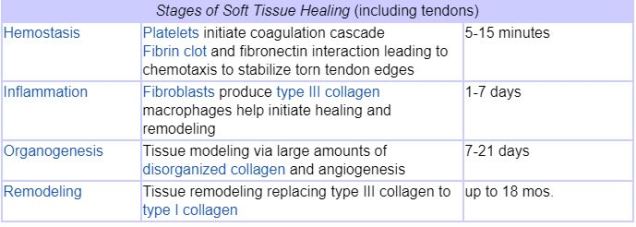
Remodeling is frequently discussed in literature as the final stage of tendon healing following injury (eg. partial tendon rupture) as seen below:
OrthoBullets on Stages of Tendon Healing
Final stability is acquired during the remodeling [phase] induced by the normal physiological use of the tendon. This further orientates the fibres into the direction of force. In addition, cross linking between the collagen fibrils increases the tendon tensile strength. During the repair phase, the mechanically stronger
type 1 collagen is produced in preference to type 3 collagen, thus slightly altering the initial ratio of these fibres to increase the strength of the repair.6Mafulli, Moller, and Evans on Tendon Healing: Can it be Optimized?
We see that remodeling takes a really long time; it’s on the time-frame of several months. What does this mean for trickers?
- You should begin exercise that stimulates remodeling for type-I collagen (main performance tendon)
- Eccentric exercise
- Plyometric Exercise
- You should begin soft-tissue remodeling early on in your career
- You should be patient with your work as remodeling happens over many months
Eccentric Exercise and Plyometric Exercise stand out as strategies to facilitate adaptive soft-tissue remodeling. Controlled Ballistic Stretching is worth mentioning in this section as it has been shown to improve elasticity of tendons, an essential component of tendon health.
Eccentric Exercise
The positive motion (muscle-shortening contraction) in a loaded movement is referred to as the concentric component while the negative portion (muscle-lengthening contraction) is referred to as the eccentric component. Take the example of a calf raise:
- The eccentric component of a heel raise would use the muscle-lengthening contractions of the calf to lower the heel
- The concentric component of a heel raise would use the muscle-shortening contractions of the calf to raise the heel
Eccentric Exercise has been consistently shown to stimulate pathways for both muscle and tendon hypertrophy. For both muscle and tendon, eccentric exercise has been demonstrated to be extremely efficient in inducing mechanical loading-derived collagen synthesis as explained below:
. . .ECM collagen genes, both fibrillar (type I and III) and basal lamina (IV) types, showed a prolonged response to one single bout of lengthening contractions, being markedly expressed even after 27 days from the exercise session, suggesting a possible delayed remodeling activity of ECM. In addition, the TGF-β/Smad signaling pathway was found highly activated at the same time point, supporting the above mentioned gene expression data, as TGF-β is regarded as an up-regulator of mechanical loading-derived collagen synthesis (Verrecchia et al., 2001). The present data support the contention that ECM may have a strong role in muscle remodeling and structural assembly after lengthening contractions. . .
. . .Collagen type I α1 also presented a larger increase after ECC and Isometric exercise compared to CON; these data suggest once again that extra-cellular matrix-related remodeling could be one of the keys to interpret differences in muscle structural re-assembly in response to lengthening vs. shortening contractions (Mackey and Kjaer, 2016).
To maximize the loading-derived collagen synthesis, exercises should put the muscles and tendon under load for a longer duration (5-10s).
Application for trickers: Targets for Eccentric Exercise
- Back of the ankle (Achilles Tendon)
- Front of the Ankle (Tendons of foot dorsiflexors)
- Front of knee (Patellar tendon)
- Back of knee (tendons of the hamstring)
For the same reasons that eccentric exercise is beneficial to the process of soft-tissue remodeling, it is likewise effective for the treatment and prevention of tendon disorders.
Sports-Health defining tendon disorders:
- Tendonitis: Inflammation of the tendon.
- Tendinosis: Non-inflammatory degeneration of a tendon.
- Tendinopathy: Any tendon disorder.
Current literature support eccentric exercise as effective prevention and treatment for tendinopathies.
Tendon injuries account for 30-50% of injuries in sports.12 Specifically, chronic problems caused by overuse of tendons result in 30% of all running-related injuries, and elbow tendon injuries can be as high as 40% in tennis players.13 Incidence of patellar tendinopathy is reported to be as high as 32% and 45% in basketball and volleyball players, respectively.14Tendon pathologies not only lead to lost time and performance declines in sports, but also can result in long term damage to tendons that can affect daily function. . .
Many studies recently have substantiated eccentric exercise as an effective treatment for tendinopathies. Eccentric training may be effective for tendinopathies based on work by Williams15 who found that oxygen consumption is seven and a half times lower in tendons/ligaments than in skeletal muscle. A low metabolic rate and anaerobic energy generating capacity are needed to carry loads and maintain tension for long periods as is typical of tendons. However, the low metabolic rate results in slow healing after tendon injury. Based on data presented previously on the physiology of eccentric work requiring less oxygen consumption than concentric work, eccentric training may be ideally suited for the rehabilitation of tendinopathies.
Plyometrics
The second way to put a tendon under load to stimulate soft-tissue remodeling is with lower impact use of the stretch-shortening cycle.
The present study demonstrates an adaptive response of the collagen type I metabolism of the peritendinous tissue around the human Achilles’ tendon to physical training. The interstitial concentrations of PICP rose within 4 weeks of training and remained elevated for the entire training period, indicating that collagen type I synthesis was chronically elevated in response to training. . .
. . .Taken together, the findings indicate that the initial response to training is an increase in turnover of collagen I, and this is followed by a predominance of anabolic processes probably resulting in an increased net synthesis of collagen type I in non-bone connective tissue such as tendons. This is in accordance with recent cross-sectional observations in humans showing that the area of the Achilles’ tendon is larger in trained runners compared to untrained controls (P. S. Magnusson, personal communication). . .
For our lower legs, that means basic plyometrics. An endless number of plyometric strategies exist that can meet the above requirements but why not utilize strategies already in our arsenal from elastic power training?
- Our bounding and rebounding exercises from earlier are lower impact than tricking and hit both sides equally.
- A recovery run can offset imbalances of tricking as well as facilitate remodeling of connective tissue.
Ballistic Stretching
Ballistic stretching is a very touchy subject. There are many scathing reviews on ballistic stretching for good reason. As a modality for increasing general flexibility in an untrained population, there is hardly a worse candidate. Untrained and uncontrolled ballistic stretching with the intention of drastically increasing range of motion is a recipe for certain disaster, it’s true. Something is bound to tear in this scenario. Here, people are referring to ballistic stretching as uncontrolled dynamic stretching.
Let’s imagine another scenario: You are not stretching for overall flexibility. You are warming up for performance. You are intentionally priming the elastic components of the SSC rather than just muscle bellies themselves. This type of stretching is a controlled form of Ballistic Stretching that can be very useful to trickers. Athletes in all of sport intuit this. Martial Artists, dancers, track athletes, gymnasts, olympic weightlifters and essentially all high performing athletes make use of controlled ballistic stretching in their warm ups to prime their muscle-tendon units for SSC performance. Hitting high kicks, rounds, and hooks before you start tricking is a form of controlled ballistic stretching. Call it dynamic stretching if you still insist.
As it is still very controversial, I’ll include a few different variations and examples of both full-range and end-range Ballistic Stretches in high performing athletes so that we’re on the same page:
- WAG World Selection Camp at the Karolyi Ranch
- Michael Phelps: Back Slap on the Platform
- Triple Jumper ballistic stretching
- National Team Warm-up: USA Freestyle Wrestling
- Dmitry Klokov: Silver Medalist Weightlifter
Here is the current attitude toward Ballistic Stretching for flexibility, as stated by Jujimufu himself:
Ballistic stretching involves bobbing, bouncing, rebounding, and rhythmic types of movement. Momentum becomes the driving force that moves the body or limb to forcibly increase the range of motion in this type of stretching. You’ve seen it before. It’s the clown at the dojo or gym that sits in a stretched position bouncing up and down, up and down, up and down, getting seemingly nowhere in the stretch. We will not be discussing it any further.
I think that accurately describes the athletes above. I doubt those wrestlers are planning on making any flexibility gains there. I completely agree that ballistic stretching for flexibility training is ill-advised, however, it should be of particular interest to trickers after warm up for improved elasticity.
As the tendon structures have been assumed to be the major source of elastic component, the elasticity of tendon structures is a leading factor in the amount of stored energy.
As the role of tendons differs depending on the type of activities performed, its characteristics may also be different. Activities such as cycling, boxing, skating or swimming use predominantly positive work‐loops, and little opportunity exists for absorbing amounts of energy during these activities. A rather stiff tendon seems appropriate for this task, since not too much energy from the muscle contraction is wasted by the elasticity of the tendon. The stiffer the tendon, the faster the force is transferred to the bones, and the more efficient the concentric contraction becomes. In this way, the metabolic energy of the muscle is converted rather efficiently into mechanical work.
By contrast, in sports with SSC movements, a more compliant muscle–tendon unit may be required for the storage and release of elastic energy. A muscle–tendon unit involved in sports with high SSC movements needs a high storage capacity for potential energy and must, therefore, be sufficiently compliant.
The role of the muscle–tendon unit during different sports activities
Tricking, which depends heavily on the SSC, benefits heavily from the elasticity of tendons rather than stiffness of tendons. What type of stretching improves elasticity of the muscle-tendon unit?
we investigated the effect of a 6‐week static and ballistic stretching programme on the passive resistive torque and on the stiffness of the Achilles tendon.24 The results of the study revealed that static stretching resulted in a significant decrease in the passive resistive torque, without a change in Achilles tendon stiffness. By contrast, ballistic stretching resulted in a significant decrease in stiffness of the Achilles tendon.
Basically, ballistic stretching is bad at stretching muscle bellies and may decrease power production in a concentric-only exercise. At the same time, it is vastly superior at increasing tendon elasticity which has a net positive increase in power production for actions utilizing the stretch-shortening cycle such as the bounding and rebounding actions found in tricking.
Mobility Overview
It can be agreed that tricking requires flexibility, but not really a crazy amount in order to get into optimal positions. Most people are born with relatively complete mobility, but that is often lost over time due to a few factors:
- Lost ROM due to postural adaptation
- You didn’t use your flexibility, thus you lost it over time
- Lost ROM due to muscle tightness
- You over-used certain muscles
- Lost ROM due to soft-tissue injury
- You hurt yourself
there are many factors and reasons for reduced joint ROM only one of which is muscular tightness. Muscle “tightness” results from an increase in tension from active or passive mechanisms. Passively, muscles can become shortened through postural adaptation or scarring; actively, muscles can become shorter due to spasm or contraction. Regardless of the cause, tightness limits range of motion and may create a muscle imbalance.
Here are a couple methods at our disposal to increase muscle extensibility and reduce muscle tightness:
Static Stretching: Putting yourself in a position and holding it. Old school, yet effective.
Dynamic Stretching: Moving through positions. Also effective.
Below are 10 tests to determine how close you are to functional flexibility for tricking. If you can effortlessly move through and hold all of these positions, you should be in great shape for tricking flexibility-wise.
10 Mobility Tests for Tricking Athletes
- Seiza (heels together)
- BMAI: kids in seiza
- tests: plantar flexion
- Key for: toe point
- Full squat feet and knees together (butt on heels)
- GymnasticBodies: full squat with feet together
- tests: ankle dorsiflexion hip flexion
- Key for: injury prevention in clutch landings, tighter tucks
- Hurdler grabbing foot
- Great Cornerback: Wide hurdler
- tests: lateral hamstring
- Key for: many things including swing leg for swings
- Pancake with elbows on the floor
- Smallville: pancake
- tests: medial hamstring + adductors
- Key for: many things including rounds
- Cossack squat (butt on heels)
- Breaking muscle: cossack squat
- tests: inner hip, hip flexion, adductors
- Key for: many things including tighter tucks
- Hip flexor against wall with chest straight up
- SharamKarem: Hip Flexor on wall
- tests: hip flexor
- Key for: many things including plant leg for swings
- Side pancake grabbing foot
- GymnasticBodies: side pancake
- tests: outer torso
- Key for: injury prevention in twisting obliques
- Double pigeon
- YogaWithGisele: Double pigeon pose
- tests: outer hip
- Key for: injury prevention in hip and back
- Bridge with straight arms and legs
- GymnasticBodies: Thoracic Bridge
- tests: upper back, shoulders
- Key for: gumbi, TDR, etc
- Shoulder extension pinkies together
- GymnasticBodies: Shoulder extension
- tests: Shoulder extension, chest
- Key for: Eagle arms, injury prevention in shoulders
Myofascial Trigger Points
The word myofascial means muscle tissue (myo) and the connective tissue in and around it (fascia). Myofascial pain often results from muscle injury or repetitive strain. When stressed or injured, muscles often form trigger points, like contracted knots, that cause pain and tightness.
. . .Myofascial trigger points are an extremely common cause of pain. Trigger points are painful when pressed on, cause a shortening of the muscle fibers, and have a special property called referred pain. Referred pain means that a trigger point in one muscle can create pain in another area [such as trigger points in the muscles around the knee causing pain within the knee].
National Association of Myofascial Trigger Point Therapists (NAMTPT)
Myofascial Trigger Points, MTP, are extremely common in trickers. Let’s look at the possible causes of MTP listed by the NAMTPT:
- Repetitive overuse injuries (using the same body parts in the same way hundreds of times on a daily basis) from activities such as typing/mousing, handheld electronics, gardening, home improvement projects, work environments, etc.
- Sustained loading as with heavy lifting, carrying babies, briefcases, boxes, wearing body armor or lifting bedridden patients.
- Habitually poor posture due to our sedentary lifestyles, de-conditioning and poorly designed furniture
- Muscle clenching and tensing due to mental/emotional stress.
- Direct injury such as a blow, strain, break, twist or tear. Think car accidents, sports injuries, falling down stairs and the like.
- Surprisingly, trigger points can even develop due to inactivity such as prolonged bed rest or sitting.
Okay, so repetitive motions loaded under high tension causes MTPs. Sounds a bit like tricking, huh? So if we know this is going to happen, can we do something to offset it?
Latent vs. Active MTP
Trigger points can be latent or active. Latent trigger points begin to cause mild dysfunction and poorer movement patterns. The MTP itself may be tender to the touch, but are not yet causing referred pain. They may be hidden until they become active following more and more repeated stress. Active trigger points may be debilitating to nearby joints and cause referred pain. It would be wise to try to “release” latent MTPs before they become active and to take serious action against active MTPs before they become too debilitating.
Common Tricking MTPs
- Calf (Gastrocnemius, soleus, peroneals, tibialis posterior)
- shin (Tiibialis anterior)
- Lateral quad (Vastus Lateralis)
- Butt (glutes, piriformis)
- Hip flexors & tensor fascia lata (TFL)
- Low back (Lumborum, longissimus, illiocostalis)
- Plantar fascia
Check out some interactive trigger point maps below:
Self-Myofascial Release (SMR)
Self-myofasial [trigger point] release has been quite prevalent in the fitness world lately. There are a million techniques out there to hit any array of MTP involving bands, sticks, balls, rollers, or just your own two hands. Use whatever works for you.
My own battle with knee pain had apparently stemmed from excessive lateral strain on the knee during TDR, sideswipe, and the like. The self-massage of the lower trigger points of Vastus Lateralis as depicted below alleviated a lot of the associated pain.
Trigger Point Therapist: Vastus lateralis
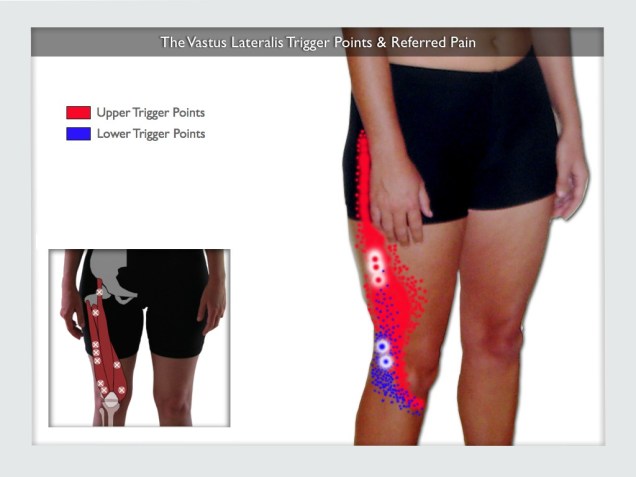
Laurens Fitness on Calf Trigger points
I can’t tell you exactly what trigger points will pop up for you. Nor can I prescribe a one-size-fits-all remedy for those trigger points. Actively seek out your own active AND latent MTPs and work on them!
 Mercenary Tricking




2 thoughts on “4P (4): Physicality”