
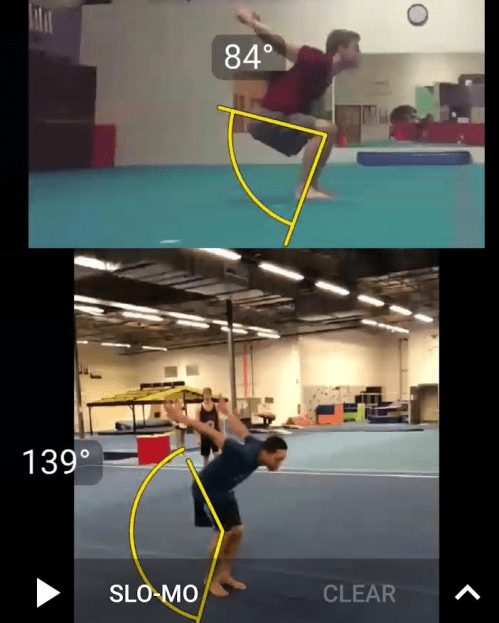
- Self-taught Trickers tend to squat a bit lower to allow strong leg muscles to drive an explosive movement
- Gymnasts are trained to use a more elastic movement which requires very little knee bend and is more similar to tumbling passes
Quick Briefing on the Fascial System
Fascia is the connective tissue that encapsulates and integrates the structural elements of the body–muscle, tendon, ligament, and bone. Fascia is the stuff responsible for transmitting forces between these structures. While each of these structures should be incredibly robust, muscle, tendon, and fascia are going to be our key focus.
- Muscles contract to produce an internal force on a tendon
- Initial velocity and counter-movements (run-up and arm swing respectively) can be summed to an external force on a tendon
- Tendons acts as a thick elastic band with the ability to majorly multiply an internal or external force
- Fascia acts as a thin elastic sheet with the the ability to minorly multiply an internal or external force to and from each of our structures
The Difference Between an Explosive Movement and an Elastic Movement
In any type of athletic movement, muscle will transmit force to a tendon, then from a tendon to a bone via the fascial system. The difference is where the primary force comes from in each movement.
- In an explosive movement (jump): Muscles provide the primary forces transmitted to the tendon. Initial speed and counter-movements provide the secondary forces.
- In an elastic movement (bound/rebound): Initial speed and counter-movements provide the primary forces. Muscles provide the secondary forces.
The advantage of an explosive movement is that strong muscles can contract to put forces on the tendon from a stand-still. The downside is that it is slow and low-powered. Tendon and fascia can rebound many times faster than a muscle can contract.
The advantage of an elastic movement is that you can produce the greatest forces possible with your body. The downside is that if you start from a standstill, you have very little starting forces to multiply.
Why don’t gymnasts squat down low for their standing flips?
Although both trickers and gymnasts perform standing backflips, they do it for different reasons. For tickers, the goal is often just to be able to do it as a skill or to do it high. For gymnasts, it should be a drill for elasticity of the lower limbs and rotation of a dismount from a rebound.
Aside from beam, gymnasts don’t compete standing skills, as they are a sub-maximal display of elastic movement. As such, gymnastic technique will be quite a bit different from a trickers’. Of course there are many exceptions to the rule on both sides, but the general idea is that gymnasts will barely squat at all whereas many self-taught individuals tend to squat pretty low.
Below we’ve got a comparison between the tricker style of standing flips and the gymnastic style. The difference isn’t height–you can get high with either technique. It’s rather that trickers tend to squat down a lot more to produce an explosive movement as compared to gymnasts who tend to squat as little as possible to mimic an elastic movement.
Here’s Clarence, our poster child for powerful legs soaring at 102kg! If you see a gymnast jump that high at that weight send me a video!
Brenden Morrison’s stall back tuck is a pretty good example of good normal tricker standing flip take-off: 90 degree squat to allow strong leg muscles to power both height and rotation.
Aaron Cook’s standing tuck is definitely an outlier on height. Even so, it is a textbook example of the gymnastics style backflip–as little knee bend as possible to test the springiness of the lower legs.
Springy confirmed.
Does it matter?
Not really. They have their advantages and disadvantages as noted earlier.
- Explosive movements require powerful leg muscles
- Powerful leg muscles provide a good internal force
- Powerful leg muscles will be a good driving force for an explosive movement
- Powerful leg muscles will add a little bit of extra driving force to an elastic movement
- Leg power is trained through standing jumps and weight training to maximize muscle recruitment.
- Powerful leg muscles provide a good internal force
- Elastic movements require a powerful fascial system
- A powerful fascial system will multiply internal and external forces
- A powerful fascial system will be able to majorly multiply the driving force for an explosive movement
- A powerful fascial system will be able to majorly multiply the internal and external forces of an elastic movement
- The fascial system can be trained through bounding and rebounding jumps to maximize elasticity
- A powerful fascial system will multiply internal and external forces
For more information on training elasticity and explosiveness, check out 4P (4): Physicality.
 Mercenary Tricking